

Posidonia in Formentera: the underwater treasure that protects its waters
Discover posidonia, the seagrass that keeps Formentera’s sea so clear, and what you can do to protect it during your visit.
What is posidonia?
When you see the crystal-clear turquoise water around Formentera, there is a silent hero behind it: Posidonia oceanica. It is a marine plant with roots, stems and flowers (not a seaweed) that lives only in the Mediterranean and forms vast underwater meadows between Ibiza and Formentera.
Posidonia helps keep the water clean and clear, protects the beaches from erosion, provides shelter for fish and other marine life and produces oxygen. The meadows between Ibiza and Formentera, considered among the best preserved in the Mediterranean, are part of the “Ibiza, Biodiversity and Culture” site, declared a UNESCO World Heritage Site in 1999.
A curious fact: in 2012, a study published in the journal PLoS ONE estimated that a posidonia clone found in Formentera is around 100,000 years old, which would make it one of the longest-lived organisms on the planet.
Where to find posidonia in Formentera
The best-known meadows are in ses Salines Natural Park, in the waters between Formentera, s’Espalmador and Ibiza, but there is posidonia across much of the island’s seabed. You will see it as dark patches under the turquoise water, next to the pale sandy bottom.
You will also find it on the shore: the brown “seaweed” that sometimes covers the sand is made up of dead posidonia leaves. They protect the beach from erosion, so they should not be removed.
Why it matters to protect it
Posidonia grows very slowly and, if it is damaged, it takes a very long time to recover. One of its main threats is boat anchors: an anchor and its chain can rip out in no time clumps that have taken centuries to grow.
That is why, in the Balearic Islands, anchoring on posidonia is generally prohibited (Decree 25/2018 of the Balearic Government). In ses Salines Natural Park there are also mooring buoy fields, such as those in s’Alga bay, on s’Espalmador, and at Caló de s’Oli, in Formentera, where you must tie up to the designated buoys instead of anchoring.
What you can do as a visitor
- Do not stand on or pull up the posidonia when you go snorkelling.
- If you are on a boat, always anchor on sand or use the buoys in the regulated mooring fields.
- Check the posidonia maps before anchoring: the Balearic Government’s map viewer (ideib.caib.es/posidonia) shows where the meadows and buoy fields are.
- Do not remove the dried posidonia from the beach: it is there for a reason.
Responsible snorkelling
Snorkelling over a posidonia meadow is a unique experience: you will see shoals of fish moving among the leaves and understand why it is called the garden of the Mediterranean. Always swim above it, without touching the bottom, and do not stir up the sand next to the clumps.
And if you want to go deeper and dive among the meadows, the go-to centre on the island is Formentera Divers, in la Savina.
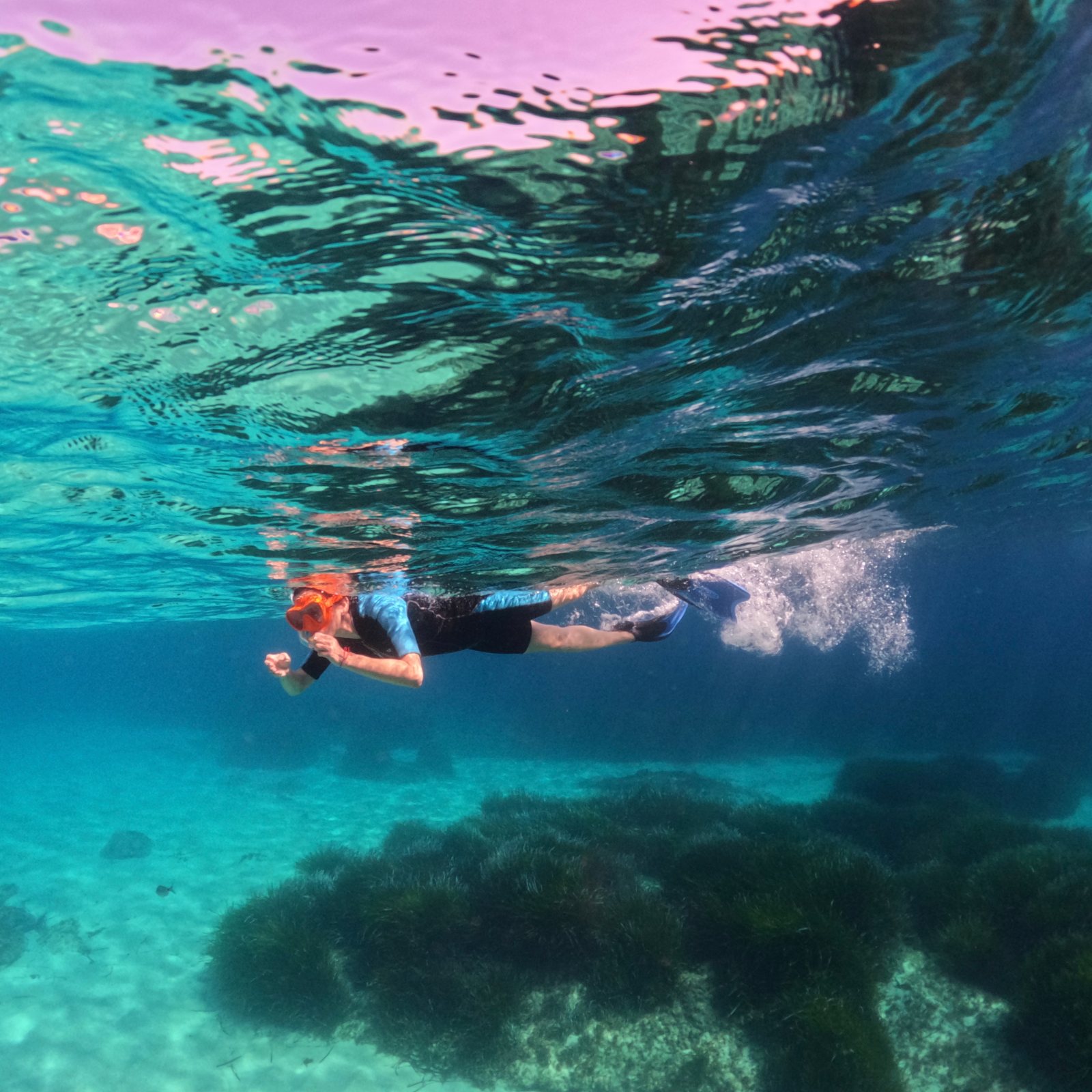
Photo: Formentera Divers
Caring for it from the sea too
With boat hire in Formentera you can reach areas where the water is so clear that you can see the meadows from the surface. At Isla Azul we also organise excursions and snorkelling trips to discover the island’s seabed.
If you are sailing on your own, remember the golden rule: always anchor on sand, never on posidonia. That way you help make sure the clear sea you have fallen in love with stays that way for those who come after you.
A treasure you cannot see… but you can feel
Many people never notice posidonia, but it is vital for everyone. Formentera would not be what it is without it. Next time you go for a swim, admire the colour of the water or walk along the sand, remember this silent plant that makes it all possible.

